
Image: The Otsuka Group's Osaka headquarters building, photographed by Tokumeigakarinoaoshima, via Wikimedia Commons (CC BY-SA 4.0), cropped.
On March 27, 2026, Otsuka agreed to buy Transcend Therapeutics, a five-year-old New York biotech with one drug in late-stage testing, for $700 million upfront and up to $525 million more, a total of $1.225 billion. The deal closed in June.
The timing is what makes it interesting. Transcend's first Phase 3 trial had only just started recruiting. Otsuka paid a premium price for a drug, a pill form of methylone called TSND-201, whose pivotal results won't arrive until around the end of 2027.
Big drugmakers don't usually pay that much before Phase 3 data. So why did Otsuka? The short answer is four things at once: a failed PTSD bet of its own, a patent clock on its biggest psychiatry drugs, a drug that doesn't need a therapist in the room, and a market that hasn't had a new PTSD medicine in a quarter century.
The Deal in Numbers
| Term | Detail |
|---|---|
| Buyer | Otsuka Pharmaceutical, through its U.S. arm, Otsuka America |
| Target | Transcend Therapeutics (New York, founded 2021) |
| Upfront | $700 million in cash |
| Contingent | Up to $525 million, tied to future sales milestones |
| Total | Up to $1.225 billion |
| Announced / closed | March 27, 2026 / June 2026 |
| The drug | TSND-201 (methylone), for PTSD |
| Stage at signing | First Phase 3 trial recruiting; Phase 2 published |
Source: Otsuka press releases, March 27 and June 15, 2026.
One detail matters more than it looks. The extra $525 million is tied to sales, not to FDA approval. Otsuka only pays it if TSND-201 reaches the market and sells. The risk of failure in Phase 3 sits mostly with the $700 million already paid; the upside is shared with Transcend's old investors only if the drug works commercially.
Reason 1: Otsuka Already Tried to Win PTSD, and Lost
Otsuka has been in psychiatry since the 1970s and is best known for antipsychotics: Abilify, its long-acting injection Abilify Maintena, and Rexulti, which it sells with the Danish drugmaker Lundbeck.
Otsuka and Lundbeck asked the FDA to approve Rexulti combined with the antidepressant sertraline for PTSD. On July 18, 2025, an FDA advisory committee voted 10 to 1 that the data didn't show it worked. On September 20, 2025, the FDA rejected the application, saying it did not provide "substantial evidence of effectiveness."
Six months later, Otsuka bought Transcend.
You don't have to squint to see the connection. Otsuka had spent years building a PTSD case, knows the doctors who treat it, and had just watched its best route into that market close. TSND-201 gave it another way in, with a different mechanism.
How Investors Reacted
Here's the surprise: the market barely flinched at either PTSD setback, and it gave the Transcend deal only a mild welcome.
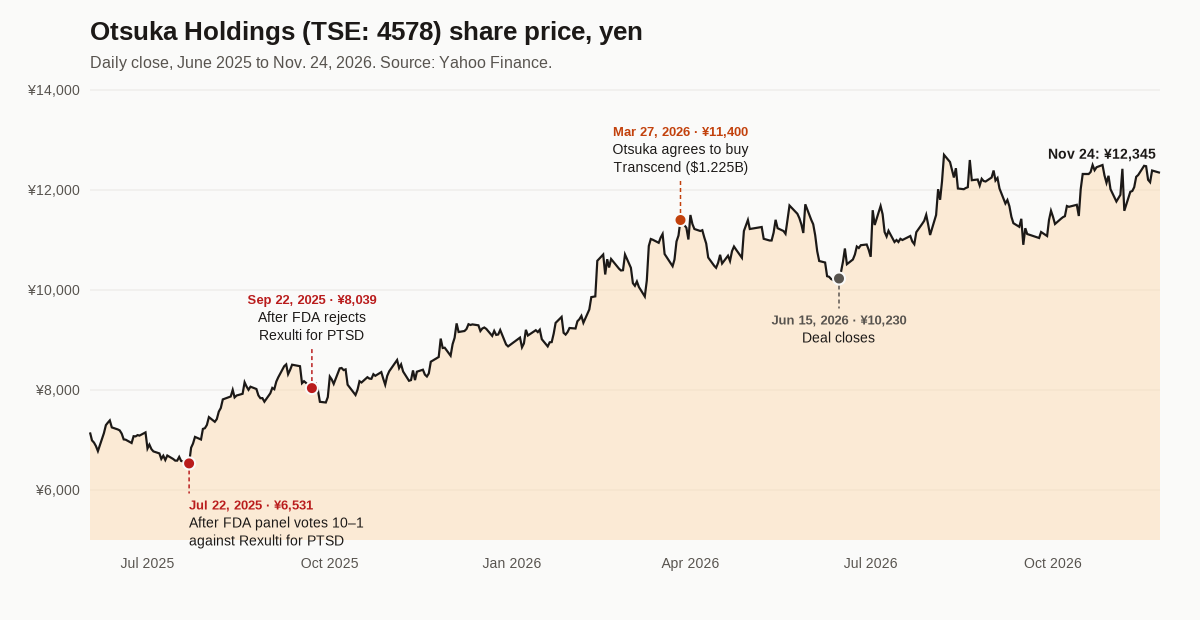
- After the FDA panel's 10-to-1 vote (Friday, July 18, 2025, U.S. time), Otsuka's shares closed the next Tokyo trading day, July 22, down about 0.8%, at ¥6,531.
- After the FDA's rejection (Saturday, Sept. 20, 2025), the stock fell about 1.3% the following Monday and was down about 4.6% by the end of that week.
- Around the Transcend announcement (March 27, 2026), the shares went from ¥11,090 on March 26 to ¥11,245 on March 30, up about 1.4%.
- Since the panel vote, the stock has risen about 88%, to ¥12,345 on Nov. 24, 2026.
Stock moves have many causes, so don't read too much into any single day. But the pattern says something: investors never priced in much value for Rexulti in PTSD, and they've rewarded Otsuka for record results since, including Rexulti sales growth of 24% in 2025. A $700 million deal is small for a company of Otsuka's size, which is part of why the market shrugged.
The Opportunity Otsuka Lost, and Wants Back
In its own announcement, Otsuka pointed out that U.S. PTSD treatment "remains limited to psychotherapy and antidepressants." That last line is the opportunity. Only two drugs are FDA-approved for PTSD, the antidepressants sertraline (Zoloft) and paroxetine (Paxil), both approved around the turn of the century. Many patients don't respond to them.
Reason 2: The Patent Clock
Big drugmakers buy late-stage drugs to replace revenue that is about to disappear. Otsuka's psychiatry business leans heavily on two franchises, and the numbers are large:
| Drug | What it treats | 2025 sales | Change |
|---|---|---|---|
| Rexulti | Depression (add-on), schizophrenia, agitation in Alzheimer's dementia | ¥331.3 billion (about $2.2 billion) | +24% |
| Abilify Maintena | Schizophrenia, bipolar I (monthly injection) | ¥224.5 billion (about $1.5 billion) | +2.5% |
| Abilify Asimtufii | Same, every two months | ¥34.8 billion (about $230 million) | +84% |
Source: Otsuka Holdings results for the year to Dec. 31, 2025. Dollar figures are approximate, at about ¥150 per dollar.
Rexulti alone was about 13% of Otsuka's ¥2.47 trillion in 2025 revenue, and its patent protection is starting to thin. Several of its U.S. patents expired in April 2026; others run to 2028 and beyond, and pharmacy and patent trackers expect generic versions around the end of the decade. When antipsychotics lose exclusivity, sales can collapse quickly: when Latuda went generic in 2023, cheap copies took most of the market within months.
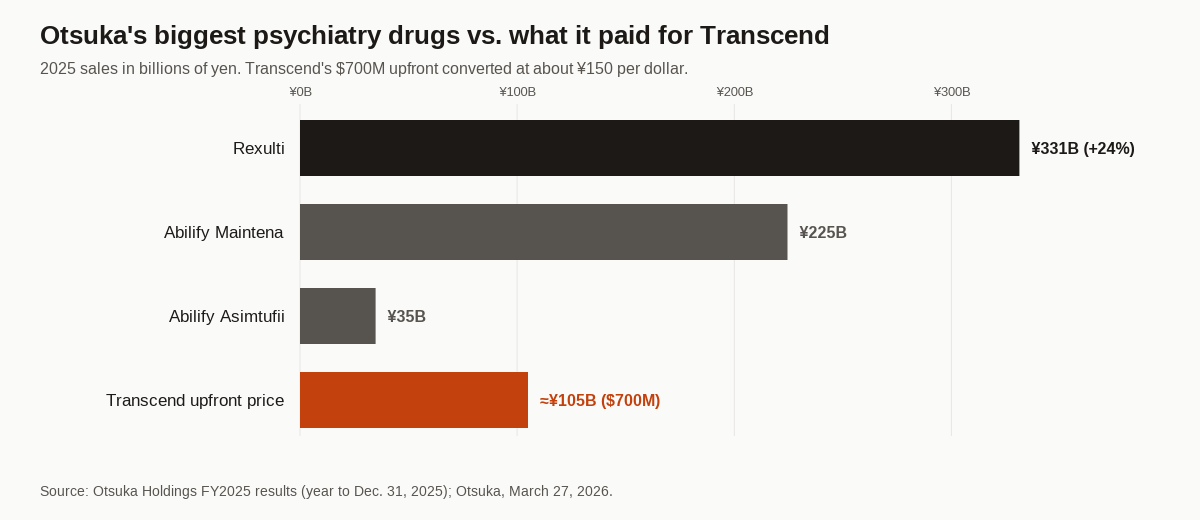
Put another way, the $700 million Otsuka paid upfront for Transcend is roughly four months of Rexulti sales.
A PTSD drug that reaches the market around 2029, if all goes well, would land almost exactly as Rexulti faces generics. That isn't an accident of timing; it is how pipeline planning works at a company Otsuka's size, which reported about ¥2.33 trillion (roughly $15 billion) in revenue for 2024, per BioPharma Dive.
Is Otsuka Japan's Biggest Drugmaker? No, and That Matters
Takeda is Japan's largest drugmaker by far, with about ¥4.6 trillion in annual revenue. Otsuka, at ¥2.47 trillion in 2025, sits in the next tier, and its total includes a big consumer business: Pocari Sweat sports drinks, CalorieMate bars and, through its U.S. subsidiary Pharmavite, Nature Made vitamins. Founded in 1921 in Tokushima, Japan, Otsuka has made psychiatry its signature, starting with Abilify, which became one of the world's best-selling drugs.
The Japanese Playbook: Buy Your Way Into America
Otsuka's deal fits a pattern that Japanese drugmakers have followed for more than a decade. Japan cuts its official drug prices regularly, and its population is aging and shrinking, so domestic growth is hard to come by. The answer, over and over, has been to buy growth in the U.S., often paying up for a company with one promising drug:
| Year | Buyer | Target | Price | What they wanted |
|---|---|---|---|---|
| 2014 | Otsuka | Avanir (U.S.) | $3.5B | Neurology: Nuedexta and an Alzheimer's agitation drug |
| 2019 | Takeda | Shire (Ireland/U.S.) | About $60B | Rare disease, global scale |
| 2023 | Astellas | Iveric Bio (U.S.) | $5.9B | Eye disease |
| 2023 | Otsuka | Mindset Pharma (Canada) | About C$80M | Psychedelic drug discovery |
| 2024 | Otsuka | Jnana Therapeutics (U.S.) | $800M | Early-stage drug discovery |
| 2026 | Otsuka | Transcend (U.S.) | Up to $1.225B | A Phase 3 PTSD drug |
Otsuka has done this before in its own core area. Its $3.5 billion Avanir deal in 2014 bought a small U.S. company for one marketed neurology drug and a pipeline candidate for agitation in Alzheimer's, the same area where Rexulti later won approval. Transcend is that playbook again: buy the promising drug before the data is final, and pay a premium for the chance to own a new kind of treatment early.
Reason 3: No Therapist Required
This is the part that most separates TSND-201 from the psychedelics racing to the FDA right now, and probably the part Otsuka valued most.
Resilient Pharmaceuticals' MDMA, which the FDA rejected in 2024 and which is back under review, is given inside a program of many hours of therapy with two trained therapists. Compass Pathways and Usona' psilocybin needs a monitored session of six hours or more. Those models are expensive, need trained staff and specialist clinics, and raise hard questions for regulators about how much of the benefit comes from the therapy rather than the drug.
TSND-201 was tested without psychotherapy. In Transcend's Phase 2 trial, patients took a pill once a week for four weeks. Methylone is chemically a close cousin of MDMA, but according to Otsuka it has no activity at the 5-HT2A receptor that causes psychedelic hallucinations. It works mainly by releasing serotonin, norepinephrine and dopamine.
For a company like Otsuka, that changes everything about the commercial model. A pill prescribed by a psychiatrist and taken in a clinic fits the sales force, distribution and reimbursement machinery Otsuka already runs for its other psychiatric drugs. A six-hour supervised session does not. It also sidesteps one of the FDA's main complaints about MDMA: when every patient knows they got the drug, and a therapist is shaping the experience, it's hard to tell what caused the improvement.
Methylone does have effects patients notice, though, so blinding will still be a question for the FDA. More on that below.
Reason 4: The Evidence Was Good Enough, and the FDA Was Friendly
Otsuka didn't buy blind. The core evidence is Transcend's Phase 2 trial, IMPACT-1, published in JAMA Psychiatry in February 2026:
- 65 adults with severe PTSD in the randomized part, at 16 sites in the U.S., U.K. and Ireland.
- Four weekly doses of TSND-201 or placebo, no psychotherapy.
- By day 64, PTSD symptoms on the standard CAPS-5 scale fell 23.3 points on the drug versus 13.6 on placebo, a difference of about 9.6 points. The gap showed up by day 10.
- 32% reached remission on the drug versus 12% on placebo.
- Side effects were mostly brief, on dosing days: headache, nausea, decreased appetite, dizziness, higher blood pressure, dry mouth and insomnia. One seizure in the drug group was judged unrelated to the drug.
The FDA had also signaled interest. It granted TSND-201 Breakthrough Therapy designation for PTSD in July 2025 and met with Transcend in September 2025 to agree on the Phase 3 design. In April 2026 it awarded a Commissioner's National Priority Voucher, which promised a much faster review.
That combination, a clean signal in a hard disease, a pill-only model, and the regulator's early blessing, is what a buyer pays up for. Waiting for Phase 3 results would have meant either a bidding war or a much higher price.
What Otsuka Is Running Now
Otsuka has moved fast since closing:
| Trial | Phase | Patients (planned) | Started | Results expected |
|---|---|---|---|---|
| EMPOWER-1 | 3 | ~300 | April 2, 2026 | ~Dec 2027 |
| EMPOWER-2 | 3 | ~300 | Sept 25, 2026 | ~Feb 2028 |
| EMPOWER-EXT | 3, long-term | ~300 | June 22, 2026 | ~Dec 2028 |
Source: ClinicalTrials.gov. Both EMPOWER trials are randomized and placebo-controlled.
The FDA usually wants two positive pivotal trials. With both reading out between late 2027 and early 2028, the earliest realistic FDA filing would be in 2028. That's our estimate, not company guidance. Otsuka also says it has picked a next-generation prodrug candidate from Transcend's labs and is doing animal studies toward a first human trial. Track all of it on our trials tracker.
What Could Still Go Wrong
This is a big bet, not a sure thing. The open questions:
- Phase 2 was small. Sixty-five patients is encouraging, not proof. Plenty of psychiatric drugs that looked good at this size have failed in Phase 3, including, in a different way, Rexulti for PTSD.
- The missing data. Transcend also completed a second Phase 2 trial, IMPACT-2 (62 patients), and a long-term follow-up, IMPACT-EXT, in late 2025. Neither has published results. Buyers normally see unpublished data before they sign, so Otsuka likely knows more than the public does, but outsiders can't judge it yet.
- Blinding. Methylone isn't hallucinogenic, but it has noticeable stimulant and mood effects. If patients can tell drug from placebo, the FDA will ask the same questions it asked of MDMA. Its final guidance on psychedelic trials in July 2026 asks sponsors to measure exactly this.
- Abuse potential and scheduling. Methylone has been a Schedule I drug in the U.S. since 2011, after it turned up in "bath salts" and pills sold as "molly." An approval would require the DEA to reschedule it, and regulators will look hard at misuse risk. The DEA is, for now, allowing more of it to be made for research.
- The voucher may not deliver. The priority voucher program that promised faster reviews has reportedly been scaled back. That matters less for TSND-201 than for Compass or Usona, since its filing is years away, but the speed advantage Otsuka paid for may shrink.
- Competition. Resilient's MDMA could reach the PTSD market first, and other companies are working on short-acting and non-hallucinogenic drugs.
The Bigger Picture: Big Pharma Picks Its Psychedelics
Otsuka's deal is part of a pattern. Since August 2025, three large drugmakers have each bought their way into psychedelic-related medicine:
| Buyer | Target | Drug | Price | Model |
|---|---|---|---|---|
| Eli Lilly | AtaiBeckley | BPL-003 (5-MeO-DMT nasal spray) and others | Up to $3.8B | Short session |
| Otsuka | Transcend | TSND-201 (methylone pill) | Up to $1.225B | No psychedelic trip, no therapy |
| AbbVie | Gilgamesh | Bretisilocin | Up to $1.2B | 60–90 minute trip |
Notice what none of them bought: a six-hour psilocybin session or MDMA bundled with therapy. Big Pharma is betting on psychedelic-derived drugs that fit the way it already sells medicine, short, simple, and scalable. Otsuka went furthest, buying a drug that takes the trip out entirely.
If EMPOWER-1 reads out positive around the end of 2027, that will look like the smartest bet of the three. If it fails, it will be a $700 million lesson that a good Phase 2 in psychiatry is still just a Phase 2.
Either way, the deal tells you where the money thinks this field is heading: away from the retreat and the therapy couch, and toward the pharmacy.
This article is for educational and informational purposes only. It is not medical, legal or investment advice. TSND-201 is an investigational drug and is not approved by the FDA for any use; methylone is a Schedule I controlled substance in the United States. If you are struggling with PTSD, talk to a qualified health professional.
Sources
- Otsuka: Otsuka Pharmaceutical to Acquire Transcend Therapeutics (March 27, 2026)
- Otsuka: Otsuka Pharmaceutical Completes Acquisition of Transcend Therapeutics (June 15, 2026)
- BioPharma Dive (Jacob Bell): Otsuka picks up PTSD drug with $700M Transcend buy (March 27, 2026)
- JAMA Psychiatry: Efficacy and Safety of the Neuroplastogen TSND-201 for the Treatment of PTSD (February 2026)
- Otsuka: Complete Response Letter for Rexulti plus sertraline in PTSD (September 20, 2025)
- Psychiatry Advisor: FDA Denies Approval of Brexpiprazole Plus Sertraline for PTSD
- Fierce Biotech: Otsuka adopts new Mindset, dropping $59M to buy Canadian psychedelic biotech (2023)
- Drugs.com: Generic Rexulti availability
- Otsuka Holdings: Consolidated Financial Results for the Fiscal Year Ended December 31, 2025 (Feb. 13, 2026)
- Yahoo Finance: Otsuka Holdings (4578.T) price history
- Fortune: Japan's Otsuka to buy U.S. drug maker Avanir for $3.5 billion (Dec. 2, 2014)
- BioSpace: Japanese Pharmas Looking Beyond Borders for M&A to US, EU
- ClinicalTrials.gov: EMPOWER-1 (NCT07456696), EMPOWER-2 (NCT07836647), EMPOWER-EXT (NCT07670702), IMPACT-2 (NCT06215261)
- Altitude: Methylone · Otsuka · Transcend Therapeutics · Trials tracker