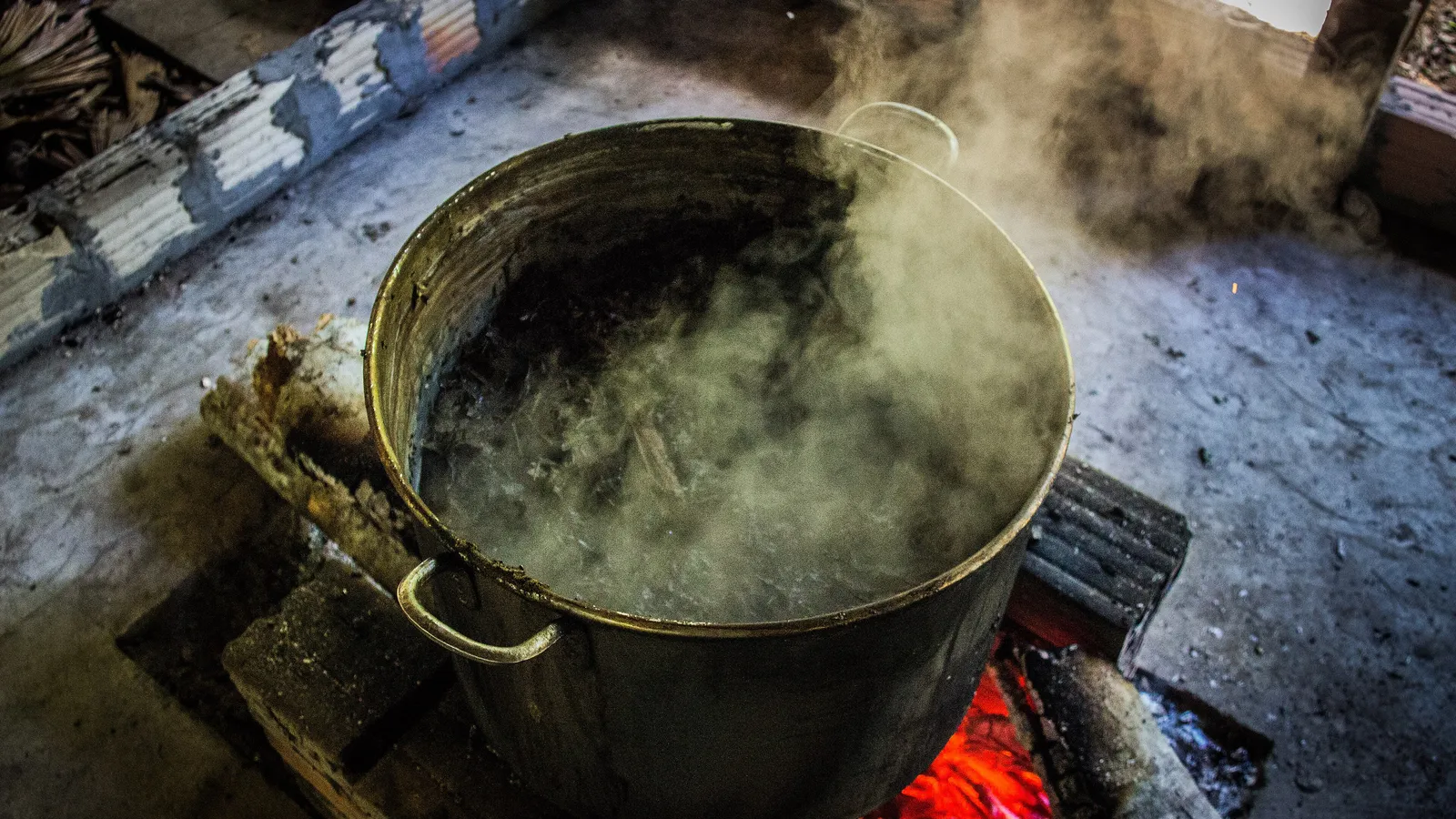
Photo: Ayahuasca brewing, by Apollo, via Wikimedia Commons (CC BY 2.0).
The short answer is no. In the US, DMT is illegal under federal law, and so are ayahuasca, the Amazonian brew that contains it, and 5-MeO-DMT, the related compound in Sonoran Desert toad venom. The longer answer has more exceptions than most people expect, and more of them are being added every year.
Mike Tyson, who says he consults "the toad" before big decisions, is the most famous user. Six of the ten celebrities in our People Series described ayahuasca. Meanwhile, the same molecules are in FDA-supervised trials. Here's what's actually legal, and where.
This article is general information, not legal or medical advice.
The Three Drugs
| What it is | How it's taken | US federal status | |
|---|---|---|---|
| DMT | A short-acting psychedelic found in many plants | Smoked or vaped (5 to 15 minutes), or injected in trials | Schedule I |
| Ayahuasca | A brew of a DMT-containing plant and a vine that stops the body breaking DMT down | Drunk as a tea, lasting several hours | Illegal, because it contains DMT |
| 5-MeO-DMT | A different, more potent compound, found in the venom of the Sonoran Desert toad and made synthetically | Smoked or inhaled | Schedule I since 2011 |
United States: Federal Law
DMT and 5-MeO-DMT are both Schedule I under the Controlled Substances Act, the category for drugs the government says have a high potential for abuse and no accepted medical use. Making, selling or possessing them is a federal crime. Because ayahuasca contains DMT, the tea is illegal too.
Research is possible with federal sign-off. Psychiatrist Rick Strassman's DMT studies at the University of New Mexico, approved in 1990, were the first new human psychedelic research in the US in a generation. He gave about 400 doses to roughly 60 volunteers over five years and later wrote DMT: The Spirit Molecule.
The DEA is moving to add more of the same family. In September it proposed placing five more tryptamines in Schedule I.
The Religious Exceptions
The biggest real exception comes from the Religious Freedom Restoration Act, a 1993 law that limits the government's power to burden religious practice.
- União do Vegetal (2006). The US Supreme Court ruled unanimously in Gonzales v. O Centro Espírita Beneficente União do Vegetal that the government hadn't shown a compelling reason to stop the church from using its ayahuasca tea, called hoasca, in ceremonies.
- Santo Daime (2009). A federal judge in Oregon reached the same conclusion for the Church of the Holy Light of the Queen, a Santo Daime church.
- Iowaska Church of Healing (2026). After years of litigation, the Iowa church signed a sealed agreement with the DEA in June recognizing its right under the religious freedom law to use ayahuasca, subject to conditions. In October, Iowa's Board of Pharmacy agreed to certify it to import ayahuasca paste and brew the tea, on one year's probation, Iowa Capital Dispatch's Clark Kauffman reported.
Few people have tracked these fights as closely as Bia Labate, the anthropologist who runs the Chacruna Institute and co-edited Prohibition, Religious Freedom, and Human Rights: Regulating Traditional Drug Use (2014). Chacruna counts the US, Canada, Brazil, Colombia and Peru among the countries where ayahuasca churches have some legal protection.
These exemptions cover specific churches and their ceremonies. They don't make ayahuasca legal for anyone else, and the DEA runs its own petition process for groups seeking one.
The States
| Where | DMT status | What it means |
|---|---|---|
| Colorado | Decriminalized for adults 21+ (2022) | Voters passed Proposition 122, which removed state criminal penalties for personal possession, use and sharing of DMT, psilocybin, ibogaine and mescaline (not peyote). There's no legal sale. The state's regulated healing centers offer only psilocybin for now. Regulators can add DMT after June 2026, but no decision has been made |
| Oregon | Illegal | Oregon's regulated program is psilocybin only. Its 2020 decriminalization of drug possession was rolled back in 2024 |
| New Mexico | Illegal | The state's new medical program is psilocybin only (our latest) |
| Everywhere else | Illegal | Under state law as well as federal law |
The Cities
Several cities have voted to make natural psychedelics, including DMT-containing plants used for ayahuasca, among their lowest law-enforcement priorities. They include Oakland and Santa Cruz in California, Ann Arbor in Michigan, Seattle, and Washington, D.C., where voters approved Initiative 81 with 76% in 2020. That isn't legalization. It's a direction to local police and prosecutors, and federal law still applies.
Around the World
DMT itself is controlled under the UN's 1971 Convention on Psychotropic Substances. The plants that contain it are not, so countries treat ayahuasca very differently.
| Country | Status |
|---|---|
| Brazil | Religious use of ayahuasca has been protected since 2006, but commerce, tourism and therapeutic use are not. Federal prosecutors pushed to reopen those rules in September |
| Peru | Traditional ayahuasca use was declared part of the national cultural heritage in 2008. Retreats operate openly |
| United Kingdom | DMT is Class A, the strictest category. Research still happens under license: neuroscientist Christopher Timmermann's team at Imperial College London ran the first brain-imaging studies of DMT |
| Australia | DMT is a prohibited substance. Australia lets authorized psychiatrists prescribe psilocybin and MDMA, but not DMT |
| France | Ayahuasca and the plants used to make it have been banned since 2005 |
5-MeO-DMT and the Toad
5-MeO-DMT is Schedule I in the US, whether it comes from a toad or a lab. The Sonoran Desert toad's venom also contains bufotenine, another Schedule I drug. Toad-derived doses are hard to measure, and the experience is short but overwhelming. That hasn't stopped high-profile users: besides Tyson, Endeavor CEO Ari Emanuel has credited toad venom with calming his famous temper.
The legal route for 5-MeO-DMT is through the FDA. GH Research is preparing large trials of its inhaled version for treatment-resistant depression, now expected in 2027. Eli Lilly bought AtaiBeckley for its 5-MeO-DMT nasal spray, which has shown results in depression trials. Helus Pharma, formerly Cybin, has been developing CYB004, a modified form of DMT itself. If one is approved, it would be that product, given in a clinic, that becomes legal, not the drug in general.
Drug Tests and Sports
DMT doesn't show up on standard workplace drug tests. Some leagues test for it anyway: the WNBA added psilocybin, DMT and ibogaine to its banned list this year.
Safety
Legal status isn't the only risk. Ayahuasca contains MAO inhibitors, which can interact dangerously with antidepressants (especially SSRIs), some other medications and certain foods. People have died at retreats, often in places with no medical support. DMT and 5-MeO-DMT can raise heart rate and blood pressure, and both can trigger frightening experiences or, in people at risk, psychosis. Anyone considering a ceremony should talk to a doctor first, especially about their medications.
What to Watch
- Whether Colorado adds DMT to its regulated program.
- More DEA religious-exemption deals following the Iowa church's.
- Brazil's review of its ayahuasca rules.
- The DEA's proposed scheduling of five more tryptamines.
- FDA trials of 5-MeO-DMT, which would create the first legal medical use.
Follow legal changes on our global legal directory and the people pushing them in Washington on our Congress tracker.
This article is general information, not legal or medical advice. DMT, 5-MeO-DMT and ayahuasca are illegal under US federal law outside narrow religious exemptions. Laws vary by state and country and change often.
Sources
- US Supreme Court, Gonzales v. O Centro Espírita Beneficente União do Vegetal, 546 U.S. 418 (2006)
- Church of the Holy Light of the Queen v. Mukasey, U.S. District Court for the District of Oregon (2009)
- Clark Kauffman, Iowa Capital Dispatch, on the Iowaska Church of Healing's agreement with the DEA (via Marijuana Moment, Oct. 17, 2026)
- Rick Strassman, DMT: The Spirit Molecule, chapter summaries (Park Street Press, 2000)
- Chacruna Institute, on Santo Daime and religious freedom; Beatriz Caiuby Labate and Clancy Cavnar (eds.), Prohibition, Religious Freedom, and Human Rights: Regulating Traditional Drug Use (Springer, 2014)
- Ballotpedia, Colorado Proposition 122 (2022))
- Ballotpedia News, Washington, D.C. voters approved Initiative 81 (2020)
- Marijuana Moment, DEA moves to ban several psychedelics (Sept. 2026)
- Chacruna Institute, Brazil's federal prosecutors and ayahuasca rules (Sept. 2026)
- Photo: Ayahuasca brewing 02, Apollo, Wikimedia Commons (CC BY 2.0)